

It was a Sunday afternoon in Ahmedabad. Priya had been carrying her 8-month-old on her hip for two hours straight — stirring dal with one hand, answering the door with the other, her back quietly screaming. Her neighbour walked in, baby snuggled against her chest in a carrier, hands completely free, making chai like it was nothing.
Priya stared. "Yaar, how are you doing that?"
Sound familiar? That moment — when you realise there's a smarter way to carry your baby — is where most Indian parents discover baby carriers. But then comes the next question: which one? Hip seat? Shoulder? Ergonomic? Detachable?
This guide breaks it all down, simply and honestly.
📦 Quick Answer
What are the main types of baby carriers in India?
The three main types are hip seat carriers (a structured waist belt with a seat for baby to sit on), shoulder carriers (soft, hands-free carriers worn over the shoulder), and ergonomic carriers (designed to hold baby in the M-shape position for healthy hip and spine development). Each suits different ages and lifestyles.
What Is a Baby Carrier — And Why Do Indian Parents Swear By Them? {#what-is}
A baby carrier is a wearable device that lets you carry your baby on your body while keeping both hands free. Babywearing — the practice of carrying your baby in a carrier throughout daily life — has been part of Indian culture for generations, though the modern ergonomic designs are far safer and more comfortable than the traditional cloth methods.
Indian parents love carriers for a simple reason: life doesn't stop when a baby arrives. Whether you're navigating a crowded Crawford Market in Mumbai, managing a joint family home in Bengaluru, or squeezing into an auto-rickshaw in Ahmedabad, having your hands free while keeping your baby close changes everything.
According to the Indian Academy of Pediatrics, close physical contact through carrying supports emotional bonding, reduces infant crying, and promotes healthy neurological development in the first year of life.
What Is a Hip Seat Baby Carrier — And Who Is It For? {#hip-seat}
A hip seat baby carrier is a structured waist belt with a firm, flat seat attached to it. Your baby sits on this seat — legs straddling outward in the natural M-shape position — while you use your arm to support them. Many modern hip seat carriers are detachable, meaning the shoulder harness clips on for younger babies and removes when your toddler is older.
This is the most popular carrier type among Indian parents right now, and for good reason.
Why Indian parents love the hip seat
Think about carrying your baby at a Diwali gathering in Pune. You're standing for hours, meeting relatives, adjusting your saree. A hip seat takes almost all the weight off your arms and distributes it across your hips and lower back. Your baby sits comfortably. You're not hunching. Your hands are still mostly free for chai and mithai.
The M-shape position — where baby's knees are higher than their bottom, forming an M when viewed from the front — is what pediatricians and orthopedists recommend. It maintains the natural curve of the infant spine and prevents hip dysplasia, a condition where improper hip positioning causes long-term joint problems.
How old does a baby need to be for a hip seat carrier?
Most hip seat carriers are designed for babies 4 months and older, when the baby has sufficient neck and head control. For younger newborns, the shoulder harness attachment provides the extra support needed.
What Is a Shoulder Baby Carrier — And When Does It Make Sense?
A shoulder baby carrier is a softer, lighter carrier that distributes baby's weight across your shoulder and torso. The baby faces inward, against your chest, held securely with adjustable straps. There's no rigid seat — the baby's weight is supported by the carrier fabric and your body.
Shoulder carriers are the hands-free parenting choice for active Indian moms and dads.
The shoulder carrier sweet spot: everyday movement
Picture this: you're in Delhi, it's 38°C in May, and you need to get through a busy market quickly. A shoulder carrier keeps baby close to your heartbeat (research shows this regulates newborn sleep patterns), doesn't add a bulky seat around your waist, and lets you move fast without anything jutting out.
They're also brilliant for Indian kitchen life. When you need to cook, rock a fussy baby, and answer a phone call simultaneously — a lightweight shoulder carrier is genuinely your best friend.
Is a shoulder carrier comfortable for long hours?
The honest answer: yes, if it's ergonomically designed. A well-made shoulder carrier should have padded straps that distribute weight across both shoulders evenly, not pull down on one side. This prevents the back strain that poorly designed carriers cause.
What Makes a Baby Carrier "Ergonomic"?
An ergonomic baby carrier is any carrier — hip seat, shoulder, or structured — specifically designed to maintain the M-shape hip position and proper spine alignment for the baby, and provide balanced weight distribution for the parent.
Not all carriers are ergonomic. Cheap carriers that hold a baby with legs dangling straight down can put pressure on the developing hip joints. The Pediatric Orthopaedic Society of North America formally recommends the spread-squat (M-shape) position as the safest for infant carrying.
The three things that make a carrier ergonomic
Hip support: Baby's knees must be higher than their bottom. The carrier seat should be wide enough to support from knee to knee — not just the crotch area.
Spine support: The carrier should support the natural C-curve of a newborn's spine, allowing it to develop correctly without forcing the back into an unnatural straight position.
Weight distribution: For the parent, weight must spread across hips and shoulders — not concentrate on the lower back. This is why waist belt design matters so much.
Newborn Baby Carrier vs Toddler Baby Carrier — What's the Difference?
This is the question every first-time parent in India asks. And the answer is simpler than most blogs make it sound.
For newborns (0–4 months): You need maximum head and neck support, the full M-shape seat, and a carrier that holds baby in the curved fetal position. Most dedicated newborn baby carriers are soft structured carriers with an infant insert, or shoulder carriers with a snug wrap position.
For toddlers (1.5–3 years): Your priority shifts. A toddler carrier needs to handle more weight (10–15 kg), allow the child to get in and out easily, and be comfortable for parents during the on-off-on cycles that toddlers love. The detachable hip seat is ideal here — your toddler can sit on the seat independently, hop off when curious, and climb back on when tired.
A mother in Chennai once told us: "My 2-year-old treats our LittleBum hip seat like his personal throne. He gets on at the market, gets off to chase a pigeon, gets back on. I don't have to stop, bend, or lift every single time."
That's exactly what a toddler carrier should do.
Baby Carrier Comparison Table: Which Type Is Right for You?
| Feature | Hip Seat Carrier | Shoulder Carrier | Ergonomic Structured |
|---|---|---|---|
| Best Age | 4 months – 3 years | 4 months – 3 years | Newborn – 3 years |
| Ideal For | Toddlers, frequent up/down | Newborns, long wear, travel | All stages, daily use |
| Hands Free? | Partially (with harness) | Fully | Fully |
| Weight Distribution | Hips + waist | Shoulders + torso | Hips + shoulders |
| Indian Summer Comfort | Good (separate belt) | Excellent (lightweight) | Good |
| Ease of Use | Very easy | Easy | Moderate |
| Best For Indian Life | Joint family, markets, outings | Kitchen, travel, festivals | Long outings, malls |
| LittleBum Option | Silver Hills Detachable | Monochrome Shoulder | Both qualify |
The LittleBum Carriers: Designed in India, for Indian Parents
Most baby carriers in India are imported or designed for Western parents. LittleBum is different — it's made in Ahmedabad, designed for Indian weather, Indian body types, and the real daily life of Indian families.
LittleBum Silver Hills Detachable Hip Seat Baby Carrier
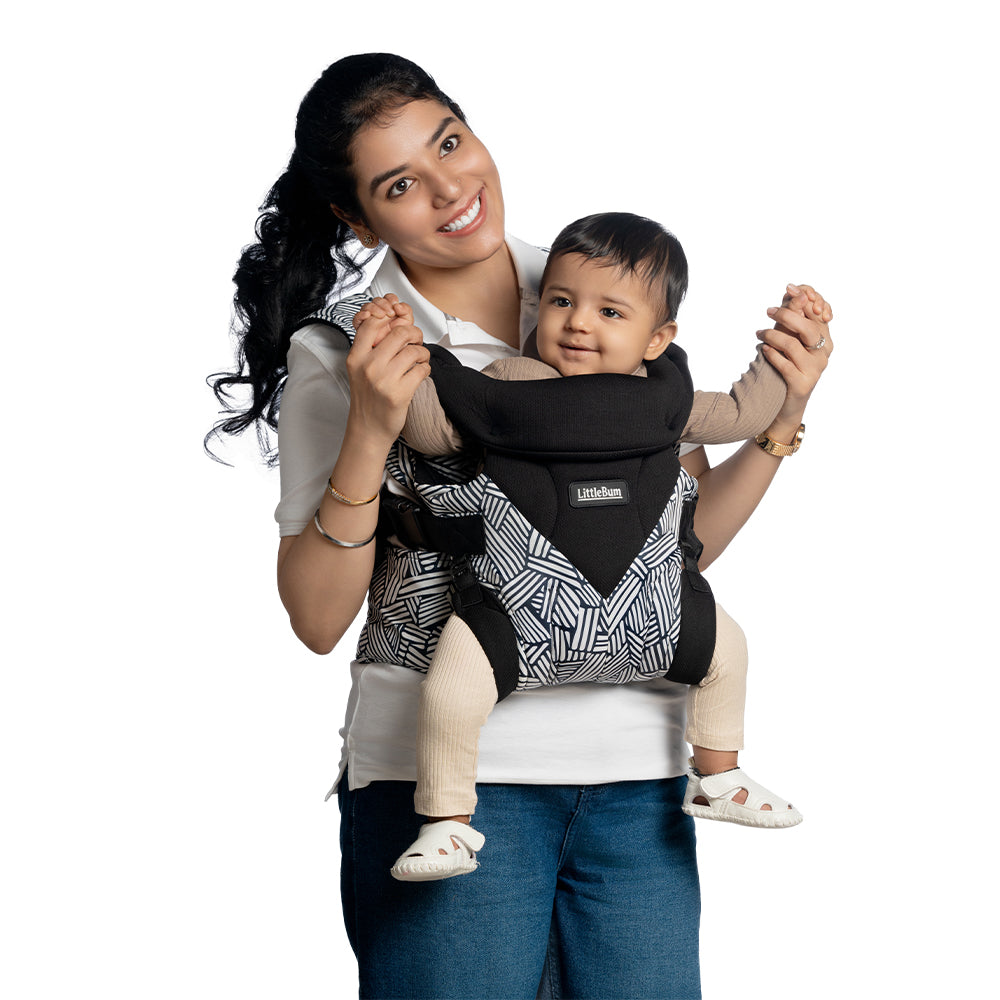
This is the carrier for parents who want versatility across every stage. The detachable design means you use the full harness for babies from 4 months to 18 months, then remove it for toddlers from 18 months to 3 years who just want to sit on the hip seat independently.
The built-in diaper bag pocket means one less bag to carry at a busy Chennai or Hyderabad hospital visit. The waist band fits up to 45 inches. Weight under 1.2 kg — you'll forget you're wearing it.
Pediatrician and orthopedist approved. Made in India with in-house quality control.
Price: Rs. 1,363 after 42% off with code INDIA42. COD available. 10-day full returns.
👉 Shop the LittleBum Silver Hills Detachable Hip Seat Baby Carrier
LittleBum Handsfree Monochrome Shoulder Baby Carrier
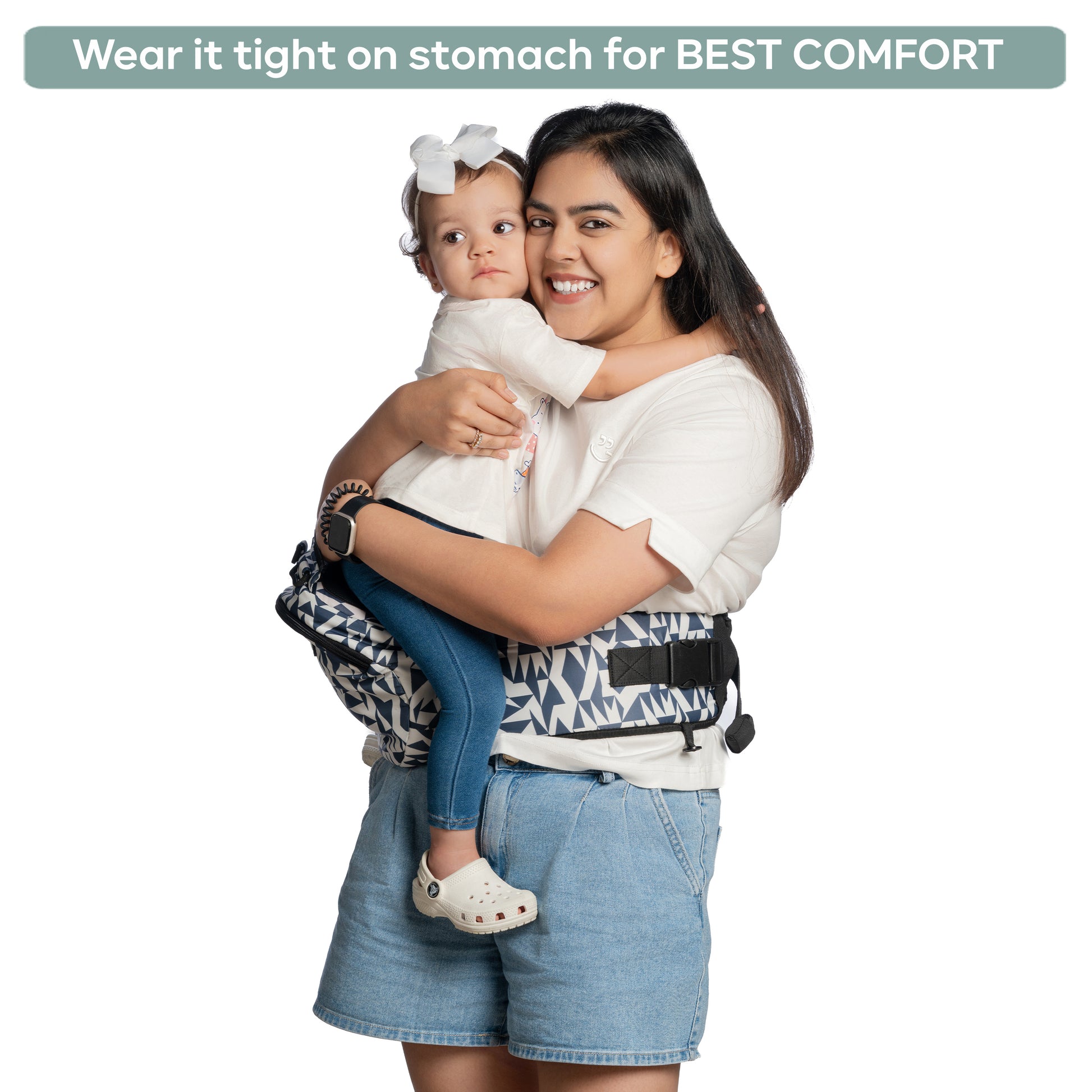
Built for parents who need to move. The Monochrome Shoulder Carrier is lightweight, clean in design, and engineered for the kind of carrying Indian moms actually do — cooking, commuting, managing the house with a baby who refuses to be put down.
Suitable from 4 months to 3 years. Ergonomic shoulder design prevents the neck strain that poorly designed carriers cause. The classic monochrome palette works with any outfit — because looking put together still matters, even on day 3 of a sleep regression.
Price: Rs. 1,073 after 42% off with code INDIA42. COD available. Free standard shipping across India.
👉 Shop the LittleBum Monochrome Handsfree Shoulder Baby Carrier
What to Look for Before Buying a Baby Carrier in India
You've seen the types. Now here's what actually matters when you're making the decision.
Age and weight range. Don't buy a carrier your baby has already outgrown or hasn't grown into yet. Check the manufacturer's minimum age — most hip seat carriers start at 4 months, not from birth.
Indian climate compatibility. A thick, padded carrier that works beautifully in a London winter will make both you and your baby miserable in a Mumbai monsoon. Look for breathable fabrics and lightweight construction.
Ease of solo use. Most Indian moms carry alone, without help. If a carrier needs two people to clip and adjust, you'll stop using it by week two. Test the buckles — can you do them one-handed?
Ergonomic certification. Ask specifically: does this carrier maintain the M-shape position? Is it approved by a pediatrician or orthopedist? Vague terms like "comfortable" don't tell you enough.
COD and returns. Buying a baby carrier online without trying it carries risk. A brand that offers Cash on Delivery and a genuine return window (not 24 hours — at least 7–10 days) is one that stands behind its product.
Baby ko sahi carrier mein carry karna utna hi zaroori hai jitna sahi cradle mein sulana — carrying your baby in the right carrier matters as much as putting them in the right cot.
Every parent in India figures out pretty quickly that you cannot do this with just two arms. The kitchen doesn't wait. The chai goes cold. The door keeps ringing. And your baby just wants to be with you — which is exactly where they should be.
The right carrier doesn't just make your life easier. It keeps your baby close, safe, and developing beautifully — while giving you your hands back.
Whether you go for the versatile LittleBum Silver Hills Detachable Hip Seat Baby Carrier or the lightweight LittleBum Monochrome Shoulder Carrier, know this: you're choosing something made in India, approved by doctors, and designed for the real life you actually live.
Your baby deserves to be close to you. And your hands deserve to be free.
FAQ: Baby Carrier Questions Indian Parents Ask Most
Q: Which type of baby carrier is best for Indian parents — hip seat or shoulder?
A: It depends on your lifestyle. Hip seat carriers work best for frequent up-and-down use with toddlers and for long standing occasions like family functions. Shoulder carriers are better for active movement, daily commuting, and hands-free kitchen work. Many Indian parents buy one of each for different situations.
Q: Is a hip seat baby carrier safe for a 4-month-old?
A: Yes, when used with the shoulder harness attachment. The harness provides the head, neck, and back support a young baby needs. At 4 months, most babies have developed enough neck control for a hip seat carrier used correctly in the M-shape position.
Q: What is the M-shape position in baby carrying?
A: The M-shape position means the baby's knees are positioned higher than their bottom, with legs spread around the carrier in a natural squat. From the front, the baby's legs form the letter M. This position supports healthy hip socket development and is recommended by pediatric orthopedists worldwide.
Q: Can I use a baby carrier in Indian summer heat?
A: Yes. Choose a lightweight shoulder carrier in thin, breathable fabric for peak summer months (April–June). Dress your baby in one thin layer less than you'd normally use. Check baby's neck and back for sweat every 20–30 minutes. Avoid carrying during the hottest part of the afternoon between 12pm–4pm.
Q: At what age can a baby use a carrier without the harness?
A: Most babies are ready to use just the hip seat (without the full harness) from around 18 months, when they have strong core control and can hold themselves upright. Always ensure the child's legs wrap securely around your waist and their weight is centred on the seat.
Q: Is a baby carrier safe for newborns?
A: A correctly used ergonomic carrier with newborn baby carrier support is safe from birth. The key requirements are: baby's airway is always visible and clear, chin is off the chest, the carrier supports the natural spine curve, and the M-shape hip position is maintained. Consult your pediatrician if unsure about positioning.
Q: How do I know if my baby carrier fits correctly?
A: The simple TICKS check: Tight enough that baby cannot slump, In view at all times, Close enough to kiss, Keeps chin off chest, Supported back. If any of these five aren't met, adjust before carrying. LittleBum carriers include a fitting guide with every order.